


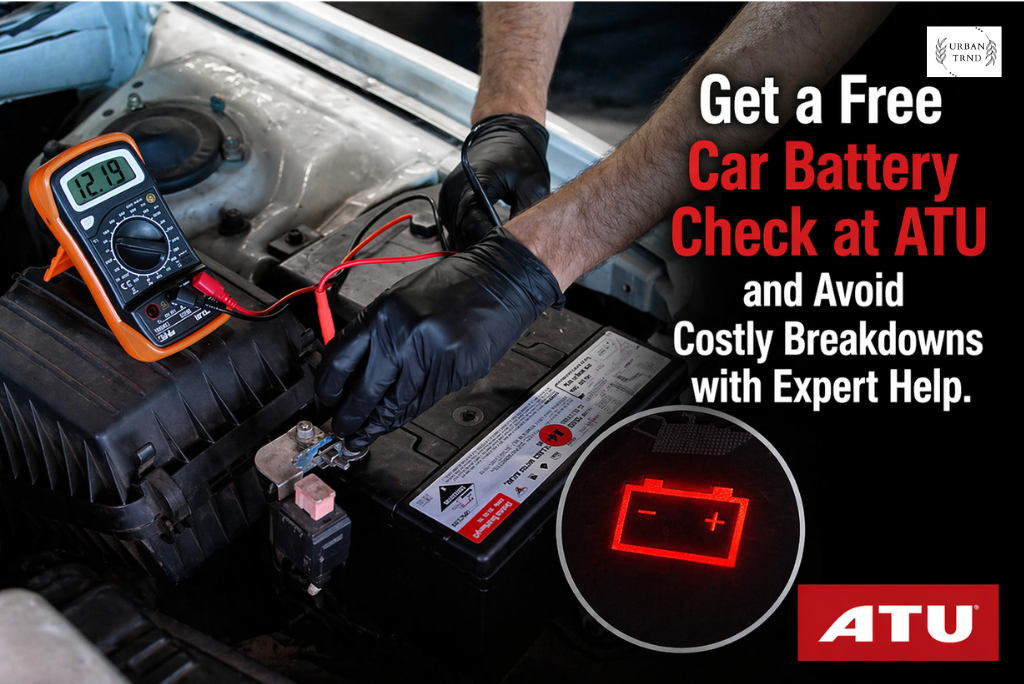
Picture this: it’s a cold Tuesday morning in January, you’re already slightly behind schedule, the temperature outside is several degrees below zero, and when you turn the key your car responds with nothing but a click. Or maybe a groan. Or worse, complete silence. A flat battery is one of the most common causes of unplanned breakdowns in Germany, and it is also one of the most preventable, because batteries don’t fail suddenly. They degrade gradually over months, sending signals the whole time — signals that are easy to read if someone with the right equipment checks them before the battery reaches the end of its useful life.
ATU offers a free car battery check at its Meisterwerkstatt branches, and it is exactly what it sounds like: a professional diagnostic test of your battery’s current state, carried out at no charge. It takes very little time. It requires no appointment in many locations. And the information it gives you could be the difference between getting to where you’re going and standing in a car park waiting for roadside assistance. If you’ve never had your battery checked, or if it’s been more than a year since the last check, this is the service to pay attention to.
What a Proper Battery Check Actually Involves
Not every battery check is the same, and the difference between a superficial look and a proper diagnostic matters more than you might expect. A battery can appear to hold a charge — it can start the car on a mild morning — while being significantly degraded and weeks away from letting you down completely. Voltage alone doesn’t tell the full story.
When ATU checks your battery, the technicians use diagnostic equipment to assess the battery’s actual health and capacity, not just its current charge state. They measure cold cranking amps — the battery’s ability to deliver the power needed to start the engine in low temperatures, which is exactly when batteries are most stressed. They examine the internal resistance of the battery, which increases as the battery ages and degrades. They look at how well the battery holds a load, which is a reliable indicator of how much useful life remains.
Beyond the battery itself, ATU’s check covers the charging system — specifically, whether the alternator is generating the correct voltage to keep the battery properly topped up while the engine is running. A failing alternator will drain even a new, healthy battery over time, and identifying that problem early prevents what would otherwise look like repeated unexplained battery failures. The two components work together, and checking both gives you a genuinely complete picture of your vehicle’s electrical health.
When the Battery Needs Replacing: ATU’s Range


If the diagnostic check reveals that your battery is approaching the end of its useful life — or has already reached it — ATU has a comprehensive battery range available. The Batterien category on atu.de and in-store at every branch covers car batteries suited to a wide range of vehicles and applications, with options across different brands and quality tiers.
Varta is one of the headline names in ATU’s battery offering, and with good reason. Varta has been producing automotive batteries for well over a century and their products are trusted by both vehicle manufacturers and independent workshops across Europe. The range covers standard passenger car batteries, but also includes batteries designed specifically for vehicles with start-stop systems, which are now standard on most modern cars and place significantly higher demands on the battery than a conventional system does.
Start-stop technology cuts the engine every time the car comes to a stop and restarts it the moment the driver releases the brake. In city driving this can mean the engine starting and stopping dozens of times per journey. A standard battery is not designed for this cycle rate and will degrade rapidly under those conditions. A start-stop compatible battery — what the industry calls an AGM (Absorbent Glass Mat) or EFB (Enhanced Flooded Battery) — handles the charge-discharge cycling properly and lasts as it should. If your car has a start-stop system and it currently has a conventional battery, this is something worth addressing.
Beyond Varta, ATU’s battery range includes other quality options that cover different vehicle requirements and budget points. The staff can advise on the right choice for your specific make and model, and the parts finder on atu.de lets you search by vehicle to ensure compatibility before you buy.
The Guarantee Extension: Protecting Your Battery Purchase
ATU offers a Garantieverlängerung programme — a guarantee extension — for automotive batteries purchased through their network. The standard manufacturer’s warranty on a car battery typically covers a defined period, but for drivers who want additional peace of mind on a purchase that plays such a critical role in their vehicle’s reliability, extending that coverage is a sensible option.
The extended guarantee programme is outlined on atu.de and can be arranged at the point of purchase. It’s a straightforward add-on that means if the battery develops a fault within the extended coverage period, you’re not facing the cost of a replacement out of your own pocket. Given that batteries are not a cheap component and that a failed battery at the wrong moment can cause costly knock-on problems — an engine that won’t start can lead to all sorts of complications — this protection is worth considering.
Booking Your Battery Appointment Is Simple
If your battery check reveals a problem that requires fitting a new battery, or if you simply want to arrange a scheduled appointment rather than walk in, ATU’s online booking system handles it cleanly. Go to atu.de, navigate to the appointment booking section, and select Batterie from the workshop services menu. Choose your branch from the nationwide network of over 528 locations, pick a time that works for you, and you’re confirmed. The whole process takes a few minutes and is completed entirely online.
As with all of ATU’s workshop services, payment happens when you collect your vehicle — not upfront. There’s no deposit required, no advance payment, and no bill that doesn’t match what you were told. The price you see is the price you pay, and the work doesn’t happen without your explicit agreement.
For the initial free battery check specifically, many branches accept walk-in visits without a prior appointment. The check itself is quick enough that it can often be slotted in without a significant wait, particularly if you arrive at a quieter time. If you want the certainty of a specific time slot, booking online takes care of that. Either way, the barrier to getting your battery checked is about as low as it can reasonably be.
Why Cold Weather and Battery Health Are Closely Connected
The relationship between temperature and battery performance is one of the most important things to understand about car batteries, and it’s why the timing of a battery check matters as much as the check itself.
At low temperatures, the chemical reactions inside a battery slow down. This means the battery produces less power — fewer cold cranking amps — than it does at normal operating temperature. At the same time, a cold engine needs more power to turn over because the oil is thicker and there’s more internal resistance. The result is that the gap between what the battery can deliver and what the engine needs is at its narrowest exactly when you’re most likely to run into problems.
A battery that’s operating at, say, seventy percent of its rated capacity might handle normal autumn temperatures with no issue. When winter arrives and temperatures drop significantly, that same battery at seventy percent capacity may no longer have enough power to start the engine reliably. The battery didn’t fail overnight — it was already degraded. The cold just made that degradation consequential.
Getting your battery checked in the late summer or early autumn — before winter driving conditions arrive — gives you the maximum window to address any issues without urgency. If the battery is fine, you drive through winter with confidence. If it’s borderline or failing, you replace it on your own terms, at a time of your choosing, rather than because you have no other option.
Signs Your Battery May Be Struggling


While a professional diagnostic check gives you the definitive picture, there are signs you can watch for between checks that suggest your battery may be approaching the end of its useful life. If your engine is cranking more slowly than usual when you start the car — particularly noticeable on cold mornings — that’s one of the clearest indicators. The starter motor is drawing more power than the battery wants to deliver.
Dashboard warning lights can also indicate battery issues, though they’re not always battery-specific — the warning light for the electrical system can point to a charging problem rather than the battery itself, which is another reason the alternator check is a useful part of the ATU diagnostic. If your car’s electronics are behaving oddly — clocks resetting, windows moving more slowly, interior lights dimming — these can all point to insufficient electrical supply.
If you’ve jump-started your car more than once in recent months, that’s a reliable signal that something in the electrical system needs attention. A healthy battery in a vehicle with a healthy charging system should not need jump-starting under normal circumstances. Repeated jump-starts without identifying the underlying cause will lead to a complete failure eventually.
None of these signs are grounds for panic, but all of them are reasons to book a check at your nearest ATU branch sooner rather than later.
ATU’s Network Means Help Is Always Close By
One of the less-obvious advantages of using ATU for battery service is the reassurance that comes from the scale of their network. With over 528 Meisterwerkstatt locations across Germany, whatever city, town, or region you’re in, there is almost certainly an ATU branch within practical reach. This is relevant both for routine checks and for situations where a battery fails unexpectedly and you need to get the car to a workshop quickly.
The consistency of ATU’s service standards across the network also matters. The diagnostic equipment, the parts quality, the training of the technicians — these are the same whether you’re in a major city or a smaller town. You know what you’re getting regardless of which branch you use, and that kind of reliability is genuinely valuable when you’re trusting a workshop with something as fundamental to your car’s operation as the electrical system.
Don’t Wait for the Warning to Become a Problem
The free battery check at ATU costs you nothing except a few minutes of your time. The information it gives you is the kind that lets you make informed, proactive decisions about your vehicle rather than reactive, expensive ones. Whether the check confirms your battery is in great shape and you can drive through winter without concern, or whether it identifies a problem that needs addressing before it causes a breakdown, you come away better informed and better positioned.
Head to atu.de to find your nearest branch and arrange your check, or simply walk in when it’s convenient. Given that a flat battery is one of the most common and most disruptive breakdowns German drivers face — and that it’s among the most preventable — taking thirty minutes to get the check done is one of the more sensible things you can do for your car this year.